
Steeped in Magic - The Folklore, Ritual and Divination of Tea by Christine Carr

Have You Ever Stopped to Wonder?
When I was given the opportunity to choose a topic for this lesson, I wanted to explore something that had only been touched on briefly during my Kitchen Witch studies. Tea leaf reading, or tasseomancy—the practice of reading the patterns left behind by tea leaves in the bottom of a cup—had been mentioned from time to time, and I believe I wrote a little about it in one lesson, but we had never really explored it in depth.
Thinking about it now, I don't think there was an online lesson or ritual where tea was ever far away. Rachel, Ness and Heather usually had a mug beside them, and so did many of us joining from home with our own cup of tea in hand.
During Rachel's Friday morning online chats, there's one little moment that always makes me smile. At some point, Peter, her husband, quietly appears with a fresh cup of tea for her. It's such a simple act, but over time it has become part of the morning's rhythm. I have a feeling many of us have come to expect it, and it just wouldn't feel quite the same without it.
It wasn't until I started thinking about this assignment that I realized I'd never really explored tea's own story. It had always been there, quietly accompanying so many moments in my own life and throughout my Kitchen Witch journey, yet I'd never stopped to wonder how one simple leaf had become such an enduring part of cultures around the world.
Tea has been part of my everyday life for as long as I can remember. I rarely let a day pass without at least one cup. Whether it's first thing in the morning, while catching up with family, celebrating good news, working through a difficult day, or simply taking a quiet moment to myself, the kettle is never far away. In fact, as my British partner and I prepare to move into our new home together, we've realized one kettle simply isn't enough! Alongside the one in the kitchen, another will be finding its home in the garage workshop, because a proper cup of tea is never far from reach.
The more I thought about my choice of topic, the more I came to see how fitting tea really was. It has quietly accompanied so many moments of my life, yet I knew surprisingly little about the remarkable journey it had taken before finding its way into my teapot. Why has this one simple plant become so deeply woven into the lives of people across so many cultures? How did it evolve from an ancient medicinal plant into a daily ritual shared by millions? And how did something as ordinary as a cup of tea become connected with the gentle art of reading the leaves left behind?
This article became an opportunity to look beyond the cup itself and explore the remarkable journey of tea—its history, its folklore, the traditions it inspired and, eventually, the gentle art of tasseomancy. More than anything, I wanted to understand why tea has held such an enduring place in homes and hearts around the world. My hope is that by the end of this journey, you might find yourself looking at your own cup of tea a little differently.
Sometimes the most extraordinary stories are hidden inside the most ordinary things. For me, all it took was the opportunity to look a little more closely at something that had always been part of my life to discover one of the world's oldest, richest and most enduring traditions.
The Story Begins with a Leaf
So where does the story of tea actually begin? This is where things get interesting, because part of what we know comes from history and part of it comes from legend.
One of the best-known stories takes us back to ancient China and the legendary Emperor Shen Nong. According to the story, in 2737 BCE Shen Nong was boiling water when leaves from a nearby tea plant fell into his pot. Instead of throwing the water away, he tasted it and discovered what we now know as tea. Shen Nong was known for his knowledge of plants and their medicinal uses, which makes the story even more interesting.
Of course, there is no way of knowing whether this actually happened. It is a legend rather than documented history, but I still love the story. What I especially like about it is the curiosity behind it. Something unexpected happens, a few leaves fall into the water, and instead of dismissing it, he tries it. I have always believed curiosity keeps us learning and growing. Once we stop being curious, life can become very predictable and limited. True or not, there is something about this story that speaks to that part of me.
What we do know is that true tea comes from the plant Camellia sinensis. One thing I learned while researching this article is that although we casually call drinks such as peppermint and chamomile "tea," technically they are herbal infusions, or tisanes. Black, green, white, oolong and pu-erh teas all come from Camellia sinensis. I find it amazing that one plant can produce teas that look and taste so completely different depending on how and where it is grown and how the leaves are handled after picking.
Tea was valued in China for its medicinal qualities long before it became the everyday drink we know today. That part didn't surprise me. I have always had a deep appreciation for plants and their healing qualities. What interested me was just how far back tea's history goes and how its place in people's lives changed over time.
By the Tang dynasty, from 618 to 907 CE, tea had become an established part of Chinese culture. It was during this period that Lu Yu wrote the Cha Jing, or The Classic of Tea, generally considered the earliest known book devoted entirely to tea. He wrote about growing and preparing tea, the water, the utensils and how it should be served.
This was one of those points in my research when I started to see tea differently. People weren't simply drinking it anymore. Thought and care were being given to the whole process of making and sharing it, something we still do today even if we don't necessarily think of it that way.
From One Culture to Another
I could probably write an entire article just about the journey tea took around the world, but for this one I was more interested in what happened once it arrived in different places.
Every culture seemed to make tea its own.
Tea reached Japan through contact with China, and Buddhist monks played an important part in its early history there. Eventually, tea became closely connected with Zen practice and developed into the Japanese tea ceremony. The principles of harmony, respect, purity and tranquillity became an important part of preparing and sharing tea.
I love the simplicity of that idea. The tea is important, of course, but so is the attention given to preparing it, the person you are sharing it with and actually being present in the moment.
Tea reached Europe through trade with Asia and by the seventeenth century had become a very fashionable, and expensive, drink. Catherine of Braganza, the Portuguese wife of King Charles II, is often credited with helping to make tea fashionable at the English court in the 1660s. Eventually it moved far beyond court life and became something we now associate so strongly with Britain that it's almost impossible to separate the two.
I have a memory from a visit with family in London that has always stayed with me. They sold antiques at an outdoor market, under covered stalls, and I went along with them one particularly rainy day. Of course, at some point, someone offered tea. I can still remember standing there, surrounded by antiques and sheltering from the rain with a hot cup in my hands. It was nothing fancy, but I swear it was one of the best cups of tea I've ever had.
Maybe it was the rain, maybe it was the setting, or maybe it was simply being there with family. I don't really know. But I think that's part of tea's magic. Sometimes the cup you remember most has very little to do with the tea itself.
Being part British myself, and sharing my life with a British partner, I find this rather amusing because that relationship with tea is very much alive and well in our house.
As I mentioned earlier, we are preparing to move into our new home, and somehow we've already had a conversation about where the kettles are going. Apparently one in the kitchen isn't enough. We will also have one in the garage workshop, where my partner, who is a carpenter, will spend a lot of his time. I laughed when we decided this, but while writing this article I realized it is actually a perfect example of what I'm talking about. Tea becomes part of the way we live without us ever really deciding that it will.
Other cultures have their own traditions. In Morocco, for example, mint tea is closely connected with hospitality and welcoming guests. The preparation may be completely different from a Japanese tea ceremony or a British cuppa, but once again tea becomes part of bringing people together.
This was something I kept noticing as I researched. The customs are different, the tea is different and the way it is served is different, but there is often a similar feeling behind it. Tea creates a reason to stop for a moment, sit down and share something with another person.
Maybe that is part of the reason it has such a hold on so many cultures.
Folklore in the Teacup
Of course, once I started looking into the folklore surrounding tea, I found all sorts of wonderful little beliefs and superstitions.
Spilling tea, for example, has sometimes been considered lucky. A tea stalk floating in the cup could mean a visitor was coming. There were even traditions involving placing the stalk on the back of your hand and tapping it to discover something about a future sweetheart.
Tea making itself collected superstitions too. Bubbles on the surface, who poured the tea, how the pot was stirred and other tiny details could all mean something depending on where you lived and which tradition you followed.
This is the kind of folklore I really enjoy. I don't necessarily need to believe that a floating tea stalk means someone is about to knock on the door to find it fascinating. What interests me is that somebody once looked into an ordinary cup of tea, noticed that little stalk and gave it meaning.
It makes me wonder how much we miss now because we are moving too quickly to notice these things.
For a Kitchen Witch, I think there is something very familiar about this way of looking at everyday life. So much of what we study involves noticing what is already around us—the plants in our gardens, the food we prepare, the seasons, the weather, the hearth and the home. Tea fits quite naturally into that world.
And this is where we finally arrive at the part I especially wanted to explore: reading the leaves themselves.
Reading the Leaves
Tea leaf reading is commonly known as tasseomancy, although you may also see the word tasseography used. Similar forms of divination can also be practiced with coffee grounds and other sediment left behind in a cup.
Although tea originated in Asia, the form of tea leaf reading most familiar to us developed much later. As loose-leaf tea became more widely available in Europe, people began interpreting the shapes and patterns the leaves made inside their cups.
What I love about tasseomancy is that you really don't need very much to try it. You need loose-leaf tea, hot water, a cup and a little time. I would add an open mind to that list too.
You prepare and drink the tea, leaving a small amount of liquid and the leaves at the bottom of the cup. The person receiving the reading can hold the cup and think about a question or something that is on their mind. The remaining liquid and leaves are then gently swirled before the cup is turned upside down onto a saucer to drain. When you turn the cup upright again, the leaves will have settled into patterns along the sides and bottom.
Then you look at what is there.
You might see a bird, a heart, a tree, an animal, a letter or a road. Someone else may look into exactly the same cup and see something entirely different. There are traditional meanings for many of these symbols. A bird may suggest news or a message, a heart may relate to love, a tree can suggest growth, and a road or line might represent a journey or path ahead.
Where the symbols appear in the cup can matter too. Depending on the method you follow, the rim generally relates to things happening now or in the near future, while symbols farther down can relate to things further away. The bottom of the cup may represent the more distant future or deeper matters. The handle is also often used as a reference point for the person whose cup is being read.
The more I read about tasseomancy, though, the more I realized that learning a list of symbols is only part of it.
Traditional meanings and symbol guides are wonderful tools, especially when you are beginning, but reading tea leaves also asks you to use your own wisdom and intuition. Rather than immediately reaching for a book to tell you what a shape means, I think there is value in sitting with the cup for a moment and noticing what you see and what you feel.
Let's say I see a dog. A book may tell me that a dog represents loyalty, friendship or companionship. That's useful information, but what does a dog mean to me, or to the person whose cup I am reading? What was the first thought that came into my head when I saw it? Did it remind me of a particular person or situation? Those first impressions matter too.
I think we all have intuition, although sometimes we become so accustomed to looking outside ourselves for answers that we forget to listen to it. Tasseomancy gives us a reason to slow down and pay attention to that inner voice.
A book can offer guidance, but ultimately no book knows the person sitting beside the cup.
For me, that is an important part of the practice. I don't think reading tea leaves has to be about predicting some unavoidable future. I see it much more as a combination of traditional knowledge, observation, our own wisdom and intuition. The leaves give us something to respond to, but we bring ourselves to the reading too.
Two people can look into the same cup and notice completely different things. I rather love that.
Put the Kettle On
When I chose this subject, I thought I was going to write an article largely about tea leaf reading. Instead, I ended up learning far more about tea itself and, perhaps more importantly, thinking about the role it already plays in my own life.
Tea has been medicine, ceremony, luxury, hospitality and an everyday drink. It has inspired folklore and superstition and eventually became a way of practicing divination.
Yet after all of this research, I keep coming back to the simplest moments.
A kettle boiling.
A favorite mug.
Peter bringing Rachel her tea on a Friday morning.
Making a cup when someone comes to visit.
Standing under a covered market stall in rainy London with a hot cup of tea in my hands.
Putting another kettle in the garage because apparently one kettle in a British household simply isn't enough.
These are such ordinary things, but perhaps that is exactly the point.
I've also been reminded of how important it is to remain curious. There are things we see and do every single day without ever stopping to wonder why. The moment we do, we can find history, folklore and traditions that have been sitting right under our noses all along.
And then there are the leaves left behind in the bottom of the cup.
We can rinse them away without another thought, or every once in a while we can stop, look a little closer and see what we find.
So the next time someone says those very familiar words—
"Put the kettle on."
—I think I will hear a little more in them than I did before.
Books & Resources
For anyone interested in exploring tea leaf reading, folklore and the history of tea further, these are some of the books I consulted while researching this article:
Holmes, Kylie. The Ancient Art of Tasseography: How to Read Tea Leaves and Coffee Grounds.
Clements, S. L. Tasseomancy: Everything You Need to Know to Successfully Read Tea Leaves.
Fenton, Sasha. Tea Cup Reading: A Quick and Easy Guide to Tasseography.
Baker, Margaret. Discovering the Folklore of Plants.
Heiss, Mary Lou and Robert J. Heiss. The Story of Tea: A Cultural History and Drinking Guide.
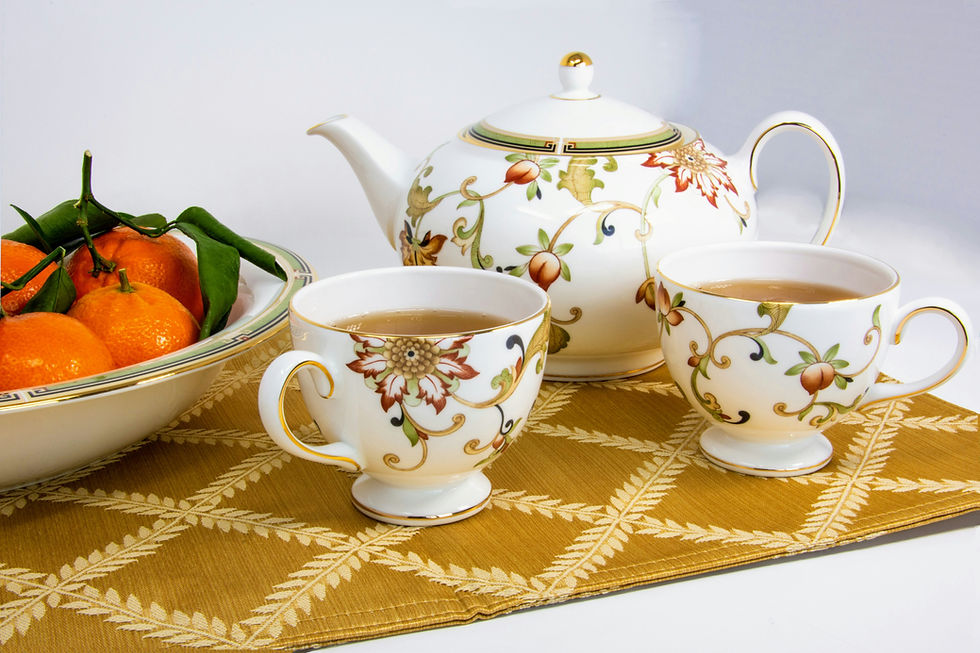
Photo by David Brooke Martin on Unsplash


.png)

Lovely article, reminds me of my relationship with tea. It started just before I was born, my mum went into labour and the first thing my grandmother did was to put the kettle on and make tea while everyone was getting dressed before leaving for the hospital, so you could say the last thing I had through my mother was a cup of tea to give me strength to come into the cold world...and I'm still enjoying tea and always will 😉